What a Carved Wall in Granada Taught Me About Language

Fadwa Al Qasem
Six words, carved into a palace wall in Granada. Read them in Arabic, English, and Spanish, and you get three different relationships to time.
I've started keeping a notebook for this. Same moment, written more than once. First in whichever language reaches for it, then again, deliberately, in another. The idea is to notice what each language keeps, and what it quietly lets go of.
Granada gave me one of the clearest entries yet.
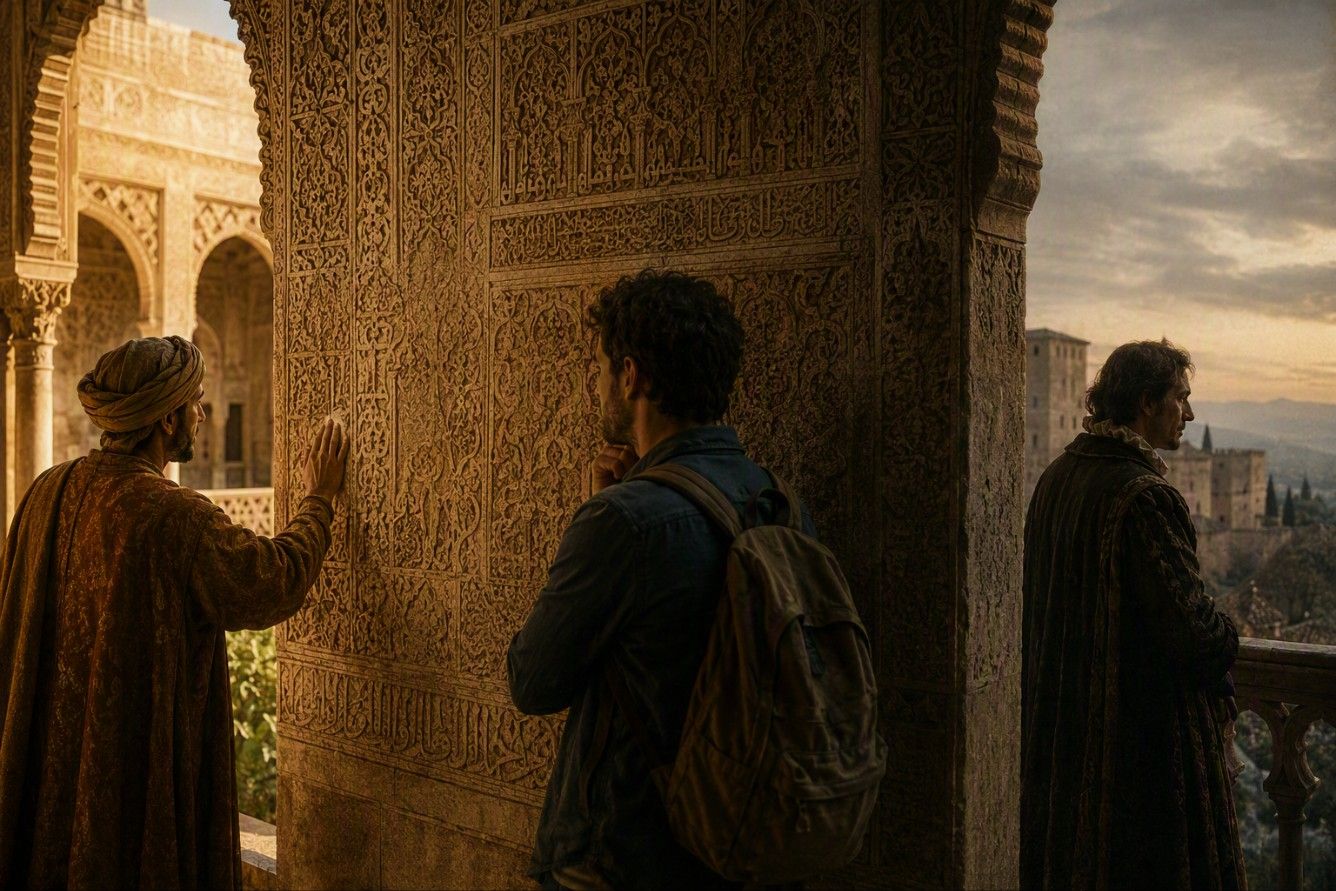
Carved into wall after wall across the Alhambra is a single phrase: لا غالب إلا الله. There is no victor but God. It was the motto of the Nasrid dynasty, repeated so often throughout the palace that it stops feeling like a sentence and starts feeling like architecture itself, something the building exhales rather than says.
In Arabic, the phrase arrives as certainty. Worn smooth by centuries of hands running along the same walls, the way stone takes on a different texture wherever it has been touched too many times to count. Nobody needed convincing. It was simply understood, woven into the walls the way load-bearing stone is woven into a structure.
In English, the same six words shift posture entirely. There is no victor but God reads almost like an argument, something offered to someone still unconvinced. English wasn't in the room when this phrase was carved. It arrived centuries later, reading the wall like a visitor, not a resident.
Then there's Spanish. No hay vencedor sino Dios. A faithful, word-for-word translation. But Spanish carries something neither Arabic nor English carries here: history that already knows how the story ends. Granada was the last Nasrid stronghold, the final piece of Al-Andalus, and it fell in 1492. Read the phrase in Spanish, standing in the Alhambra, and it does not sound like certainty or argument. It sounds like elegy. The language itself seems to know what happened next.
Same six words. Three completely different relationships to time.
Arabic holds the moment before the ending. English holds the moment of explaining the moment. Spanish holds the moment after, looking back.
I shared this thought publicly once, and two readers pushed back on it in a way I have not stopped thinking about. One asked whether the shift I was describing was really about the languages at all, or about distance. A fourteenth century Nasrid courtier heard that phrase as something lived, almost unconscious. Anyone reading it now, in any language, is reading it after the empire fell. Maybe what I was calling a difference between Arabic and English was really a difference between proximity and distance from the moment itself.
Another reader went further still. Perhaps the language is just the carrier, he said, and what actually shifts is how much history each reader brings with them when they arrive at the words. An Arabic speaker who knows the Nasrid story intimately will read the phrase differently than one who does not. The same is true in English, the same in Spanish. The three relationships to time I thought I had found in the languages themselves might really be three different distances from the same history, with language simply holding the door open.
I think both of them are right, and I think their two points are actually the same point seen from different angles. Language is never a neutral container waiting to be filled with meaning from outside. The history is not separate from the Arabic, the English, or the Spanish. For someone who carries it, the history and the language are the same thing, arriving together, inseparable.
This is what travel does to language, if you let it. It does not just translate words. It changes which century you are standing in when you read them, and how much of that century you carry with you.
I think about this constantly in the work we do at Tabeer. When a brand asks us to move its words from one language into another, the easy mistake is to treat it as a matching exercise, finding the nearest equivalent and calling it done. But a word never arrives empty-handed. It carries the moment it was written, the moment of whoever wrote it, and every moment since in which someone chose to read it again, carrying their own history into the encounter.
Twenty years into this work, that is still the thing that stops me in front of a wall like this one. The Nasrid dynasty did not survive. The words did. And depending on which language you ask, and how much history you bring with you when you ask it, those words are still proud, still arriving, or still grieving, all at once, all true.