The Russian Who Brought Us Mole Poblano

Fadwa Al Qasem
It had been a while since I visited Granada. The city that carries much nostalgia in the minds of most Arabs. These days, Granada does not announce itself as a city of many worlds. It announces itself as a Spanish city. The narrow streets, old stone, the smell of orange blossom in the evening air. And then it reveals, slowly, that it has never been just one thing.
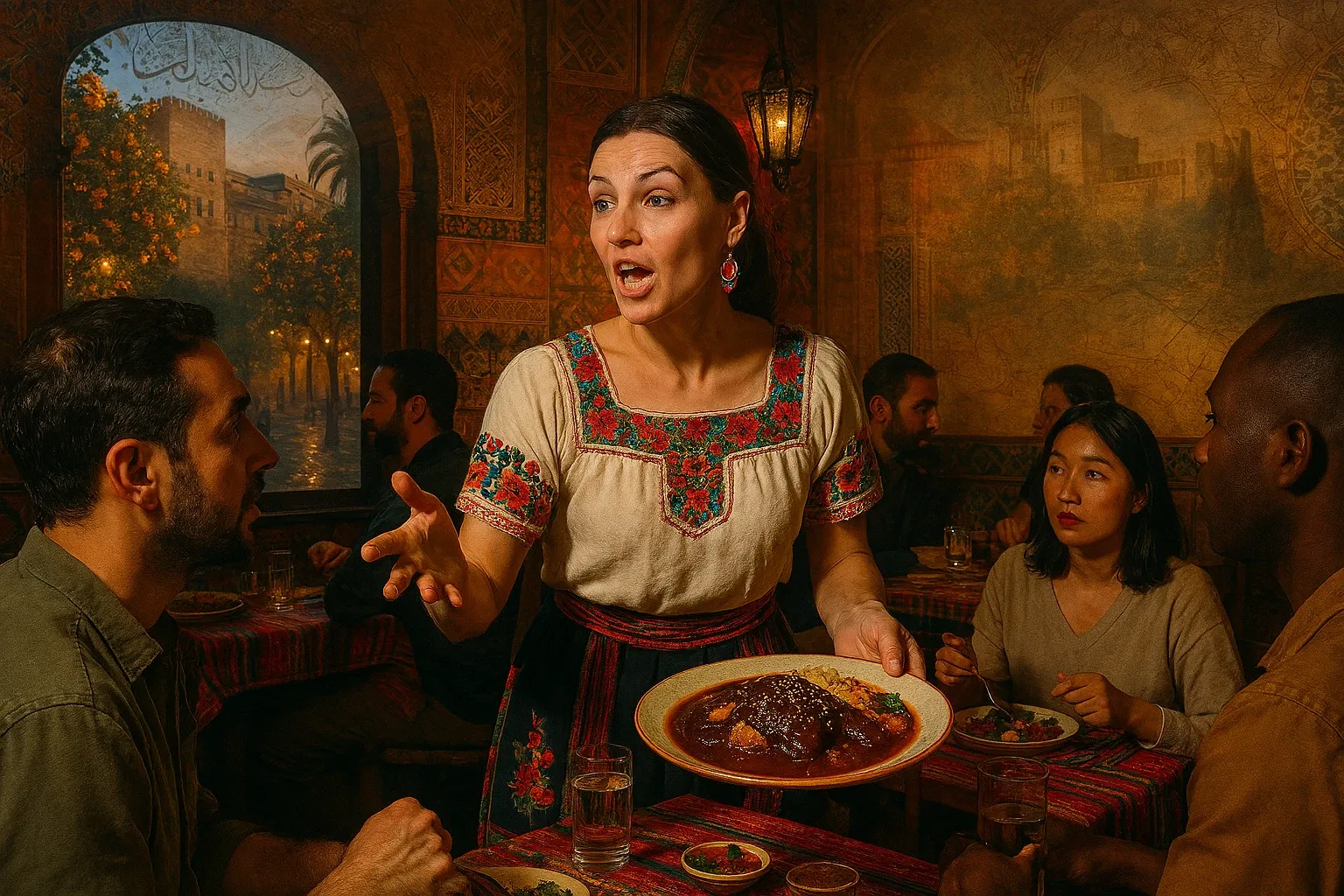
We found the Mexican restaurant by accident. The kind of accident that travel is full of. A wrong turn, an ornate wall, a door that seemed like an invitation to travel within your travels. We sat down without thinking too carefully about whether Mexican food in Andalusia made sense.
It made more than sense.
It was some of the most interesting Mexican food I have eaten. Careful. Considered. The kind of food that comes from someone who grew up with it and carried it somewhere new and spent years figuring out how to make it work in a different soil, with different ingredients, for people who had never grown up with it. It tasted like two cultures reaching an understanding.
And then, we discovered that the server was Russian. She spoke Russian and Spanish and English and moved between all three with the ease of someone who has long since stopped keeping track of which language belongs where. She brought us our food and explained it in three languages without being asked, as if it were simply the most natural thing in the world to carry several worlds at once.
I sat there thinking about what I was actually looking at.
A Russian woman, in a Mexican restaurant, in a Spanish city that was once the last capital of Arab Andalusia, telling us the history of mole poblano, to a Palestinian woman who has lived in seven countries (so far). This was not fusion. This was something older and more honest than fusion. This was what actually happens when people move. They carry what they love, they put it down in the new place, and the new place is changed by it. And they are changed by it too. The mole poblano is not quite only Mexican, and the server is not quite only Russian, and Granada is not quite only Spanish, and I am not quite only anything I started as.
This is what travel does when you let it. It does not show you other places. It shows you that every place is already other places, layered. That the city you are standing in is a palimpsest, written over and over by everyone who ever arrived and stayed and changed something by being there.
Language does the same thing. Every language carries the fingerprints of every culture that ever pressed against it hard enough to leave a mark. Spanish has Arabic inside it. In Ojalá*, in azul**, in the names of hundreds of plants and foods and mathematical concepts that Arab scholars named and left behind when the last Arab king walked out of Granada in 1492. Arabic has Persian inside it. English has French inside it, and Norse, and Latin, and a hundred other languages that arrived with people who were going somewhere and left something when they passed through.
When we help a brand find its voice in Arabic, we are not performing an act of technical skill. We are entering something that has been layered and pressed and shaped by thousands of years of people carrying their meaning from one place to another. We are trying to hear what is already there before we add anything.
The food and the conversations were good. We walked back out into the Andalusian evening, full of something that was Mexican and Spanish and Russian and, somehow, exactly right for where we were.
Every place is many places.
Every person carries more than one world.
Every language holds more than it appears to.
This is not a metaphor. It is just what actually happens when you pay attention.
* Ojalá: From the Arabic word "Inshallah", or لو شاء الله meaning "If God wills" or "God willing".
** Azul: From the Arabic lazawárd, given to the deep-blue metamorphic rock lapis lazuli.