Words That Travel
Consider this: the most widely shared ritual on earth has two completely different names.

Fadwa Al Qasem
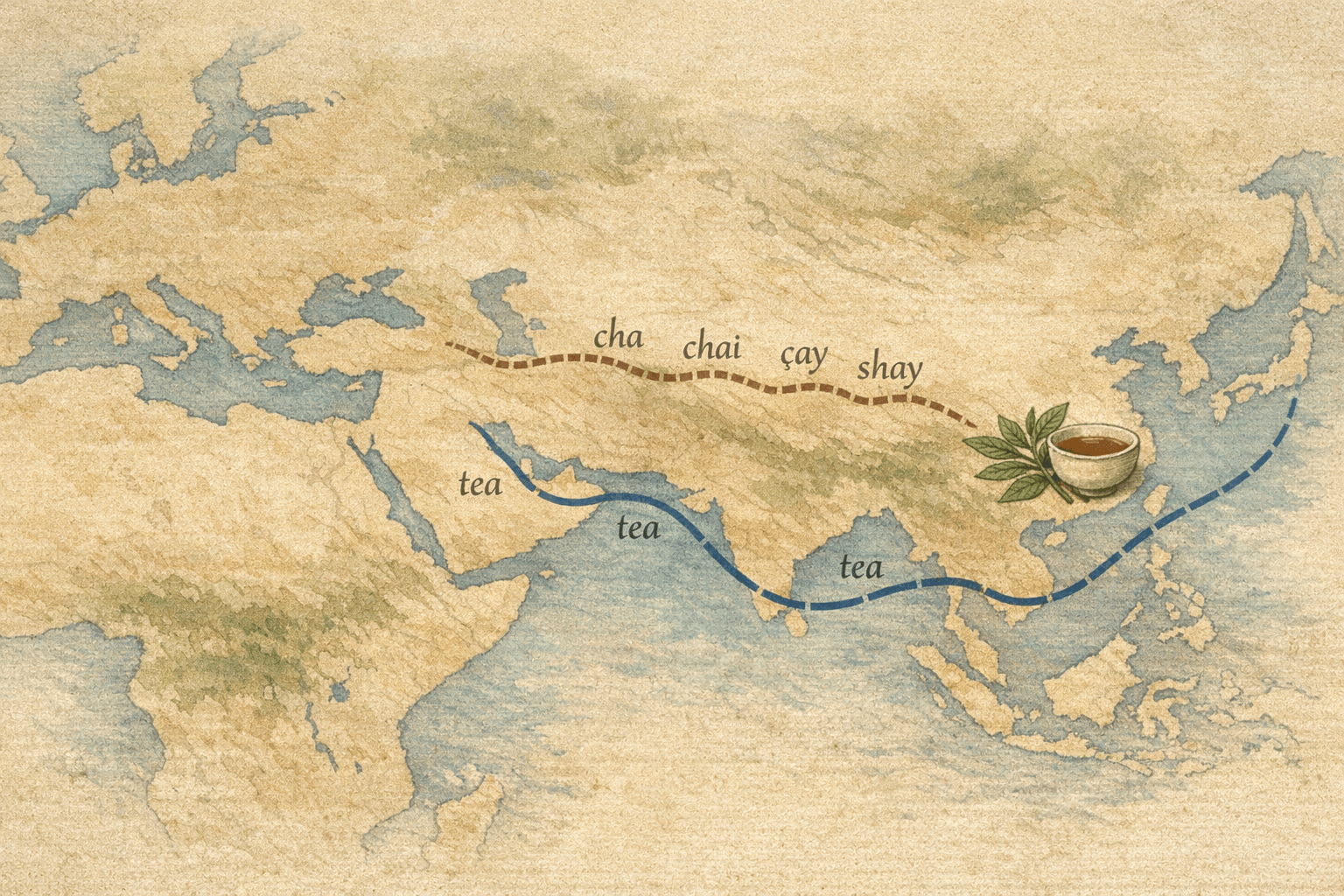
If your culture received tea by sea; through Dutch traders, British ships, trading companies moving east, you call it tea. If your culture received it by land; along the Silk Road, through Central Asia, across the Ottoman Empire, you call it chai or cha.
Two words. One map of how culture actually travels.
Language doesn't move randomly. It follows the routes of human connection: trade, exploration, conflict, love, colonization, curiosity. And when it arrives somewhere new, it doesn't replace what's already there. It adds to it. It becomes part of it. It changes, just slightly, and carries on.
I think about the moment a Dutch sailor first held a cup of something warm and dark in a port in coastal Fujian and asked: what is this? Someone answered: te. And he carried that sound home across the ocean. It became thee in Dutch, then tea in English, then something close to it in every language that received the plant by sea.
I think about the caravans moving slowly through Central Asia, the word chá passing from one set of hands to the next along the Silk Road, changing shape slightly with each new mouth that said it, until it became chai in Persian, çay in Turkish, shay in Arabic; warm and familiar in every language it touched.
The same leaf. The same plant. And yet the word you use tells a story about where your culture stood in the world, who you traded with, who you trusted enough to borrow from.
Words have always done this. Carried more than their meaning. Carried the memory of the journey that brought them to you.
I think about this often in the work we do at Tabeer. When we first began working with Forbes Arabia; helping to build the Arabic voice of one of the world's most recognized business publications, the question we kept returning to was how to let Arabic carry it. Not: what does this word mean? But: what journey has this word already taken, and does that journey bring it closer to the person you're trying to reach, or further away? How to find the words, the rhythms, the cultural references that would make a reader in Riyadh or Cairo feel that this publication understood them as the intended readers.
Language is not a container you pour your message into. This is what cultural intelligence gravitates to instinctively; it is a living record of every human encounter that shaped it.
Tabeer was built on a stubborn belief: that the words you use to reach an audience carry the weight of everything those words have been through. And that the most effective communication happens when you understand that weight.
Twenty years of working across markets; from Dubai to London, New York to Tokyo, Singapore to South Africa, taught us that the moments of real connection always came from the same place. Not from clever strategy or flawless execution. From cultural understanding. From knowing that tea and chai are the same thing, and that which word you use tells your audience everything about whether you truly know them.
We're still travelling. After twenty years, the road keeps getting more interesting.